
While back to school pictures flood our social media feeds with smiling Tulsa-area kiddos excited about the new schoolyear, many students right here in Tulsa County approach the new year with anxiety stemming from housing insecurity.
For the 2021-2022 school year, the Oklahoma State Department of Education (OSDE) reported 21,988 homeless students enrolled in Oklahoma schools (source). Locally, Tulsa Public Schools reported 741 homeless students (equivalent to roughly 30 full classrooms) while Union Public Schools reported 945 homeless students (equivalent to roughly 38 full classrooms) for the 2021-2022 schoolyear (source).
It’s not hard to imagine that housing instability can wreak havoc on a student’s capacity to learn and to thrive in an educational setting. The 2023 Homeless Children and Youth Steering Committee Legislative Report from the Oklahoma Commission on Children and Youth listed the following as educational impacts of homelessness on children and youth:
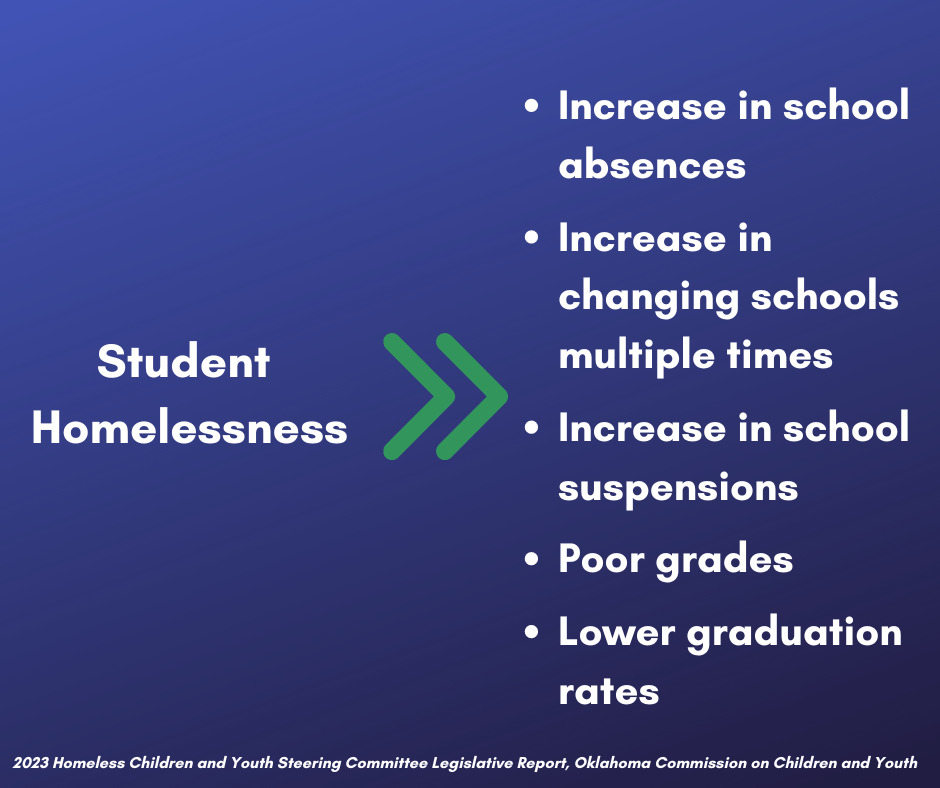
- Increase in school absences
- Increase in changing schools multiple times
- Increase in school suspensions
- Poor grades
- Lower graduation rates
Additionally, an Urban Institute report on homelessness and education states, “Any residential move can be stressful to children but frequent moves are particularly damaging, and the negative impacts appear to deepen with each additional move.”
The same report shares that around 20% of homeless elementary-age students and 10% of homeless high school students nationwide score at or above grade level in math, compared to over a third of non-homeless students, adding “several studies have similarly found that homeless and unstably housed students perform worse on standardized test compared to other poor but stably-housed children.”
Statewide chronic absenteeism has increased 6% since before the COVID-19 pandemic to today (source). At Tulsa Public Schools (TPS), chronic absenteeism for the 2023-2024 schoolyear was reported at 45.6% (source).
To encourage attendance and combat absenteeism, TPS has launched the Attend to Win! initiative, noting that “attendance is a leading indicator of student outcomes.” TPS data shows that students who live in communities with high levels of poverty are four times more likely to be chronically absent for reasons beyond their control. Attend to Win! centers on the “Big Four” contributors to absenteeism, including housing insecurity.
COVID funding allowed districts to get creative in addressing poor outcomes resulting from housing stability. San Diego launched Project Rest which provided qualifying students funds for up to five night at a hotel. School staff and those working with homeless youth said “these programs have been transformative: The stability they provide boosts school attendance and allows kids to focus on their schoolwork.”
In the program’s first 20 months, “…it has housed more than 1,200 families. Together, San Diego County and a dozen local school districts have spent around $640,000 to run it. On a single day in November, 64 students and their families were staying at hotels through the program.” (source)
Despite the success of this and other programs, COVID funding is time-limited, making sustainability challenging if not impossible. Susanne Terry, San Diego County’s homeless liaison, said, “We are headed toward a cliff where services are just going to drop.”
There’s no denying that education and housing are inextricably linked. If we want to see improved educational outcomes for our students – our future – we have to address the barriers that get in the way, including housing insecurity.
 Tulsa Housing Authority